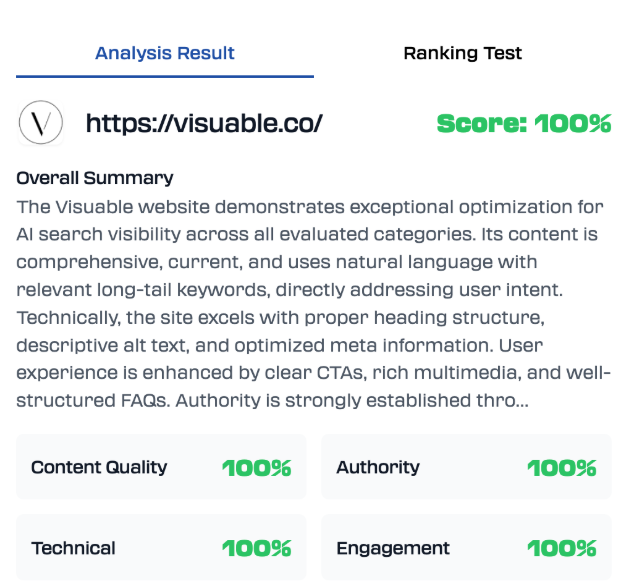
How to Optimise for AI… And How We Reached a Perfect 100% Score for AI Optimization
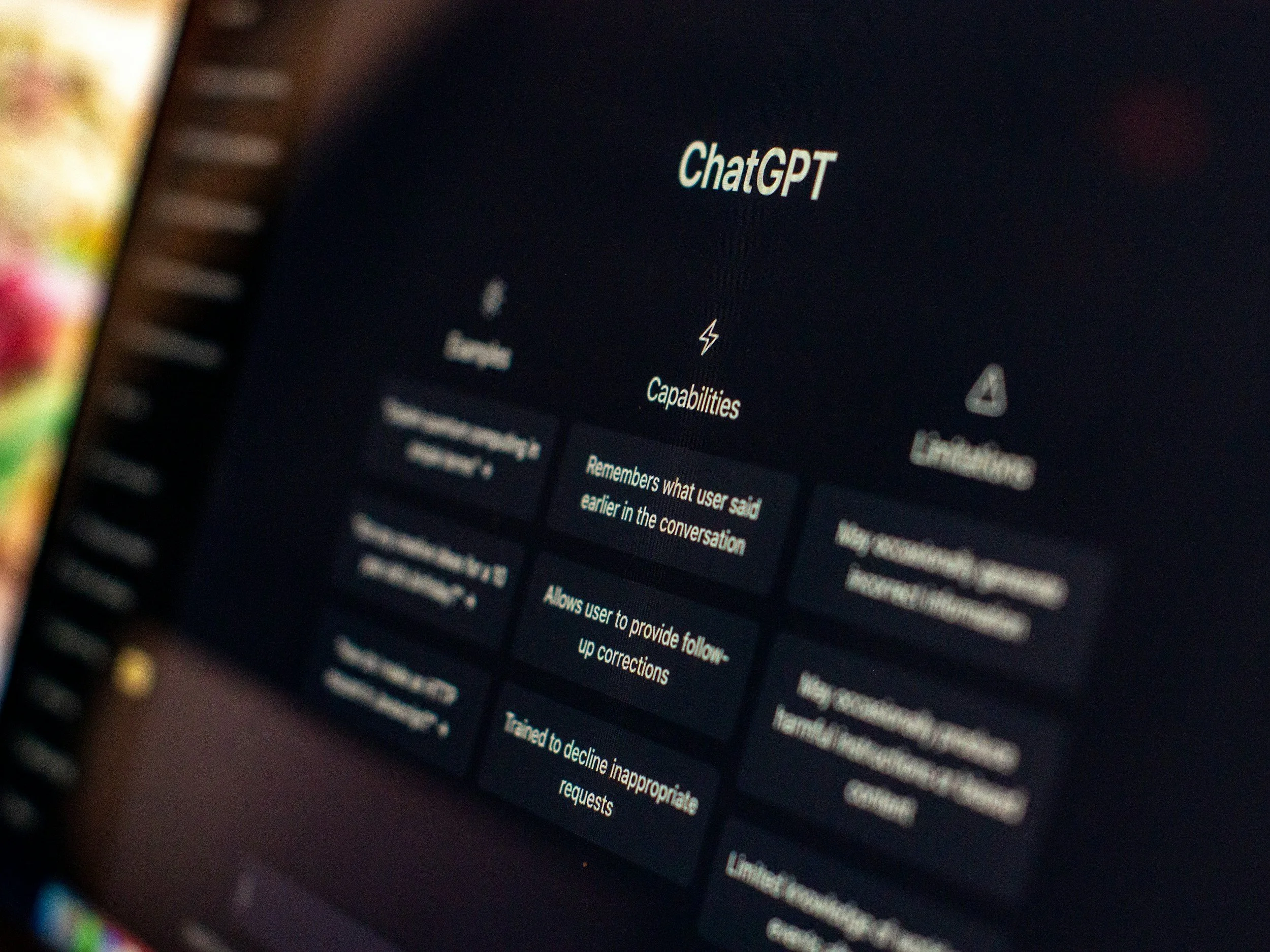
AI is no longer a “nice-to-have” consideration for your website; it’s actively shaping how content is discovered, evaluated, and recommended. From Google’s AI Overviews to tools like ChatGPT, Perplexity, and Copilot, AI systems are now key gateways between your website and your audience.
So what does that mean for your brand?
It means AI website optimisation is becoming just as important as traditional SEO, and the good news is, if your foundations are strong, you’re already halfway there.
Let’s break down how to optimise your website for AI, what actually matters, and how we achieved a perfect AI optimisation score using proven, human-first strategies.
AI and Optimisation: What’s Actually Changing?
AI doesn’t “read” websites the way humans do, and it doesn’t rank content purely on keywords anymore either.
Modern AI systems evaluate websites based on:
Clarity of structure
Depth and usefulness of content
Topical authority
Consistency across pages
Trust signals and credibility
How well information is explained and connected
In other words, AI rewards websites that are easy to understand, genuinely helpful, and strategically structured. That’s why AI website optimisation isn’t about shortcuts or hacks: it’s about doing SEO properly.
If your website is confusing, thin, or inconsistent, AI struggles to interpret it. If your website is clear, strategic, and well-organised, AI sees it as a reliable source worth surfacing.
How Did We Reach a Perfect 100% Score on AI Optimisation?
We didn’t use gimmicks. We didn’t “write for robots”.
We focused on strategy-led clarity, and that’s exactly what AI is trained to recognise. Here’s what made the difference.
1. Clear, Logical Heading Structure
AI relies heavily on hierarchy to understand context.
Every page followed a clean structure:
One clear H1 defines the main topic
Supporting H2s that break down key themes
H3s that explain, expand, and answer specific questions
This makes it easy for AI to extract meaning, relationships, and relevance — without guessing.
If your headings jump around, repeat themselves, or lack intention, AI loses confidence in your content.
2. Focused Topical Authority (Not Keyword Stuffing)
Rather than chasing dozens of loosely related keywords, we focused on owning one clear topic per page.
For this article, the topic is AI website optimisation.
We supported it with:
Natural language variations
Related concepts explained in full
Contextual examples
Clear explanations written for humans first
AI systems are trained to reward depth, not density. A well-explained topic always outperforms surface-level content filled with keywords.
3. Strategic Internal Linking
AI looks for connections.
We intentionally linked:
Related services
Supporting blog content
Core pages that reinforce expertise
This tells AI:
“This website understands its topic deeply, and has supporting content to prove it.”
It also improves crawlability, user experience, and time on site.
4. Strengthened FAQs to Match Real Search Intent
FAQs are no longer just a “nice extra”; they’re one of the clearest ways AI understands context, relevance, and authority.
We improved our FAQs by:
Writing questions exactly how real people ask them
Focusing on clarity over cleverness
Answering each question fully, not vaguely
Aligning FAQs tightly with the page’s main topic
Instead of treating FAQs as an afterthought, we used them to reinforce topical depth. If your FAQs are generic, repetitive, or sales-heavy, AI ignores them. If they’re helpful, specific, and aligned with intent, AI pays attention.
5. Optimised Image Alt Text for Meaning, Not Keywords
Alt text isn’t just for accessibility; it’s a crucial part of AI website optimisation.
We improved alt text by shifting the mindset from:
“Describe the image” to “Explain the context of the image within the page.”
Our approach:
Alt text describes what the image represents, not just what it shows
Language supports the surrounding content and topic
Keywords are used naturally, only when relevant
Every meaningful image has a clear purpose
This helps AI:
Understand visual context
Connect images to page themes
Improve content comprehension beyond text alone
Generic alt text like “woman working on laptop” adds very little. Contextual alt text like “strategic website planning for AI website optimisation” supports both meaning and relevance, without stuffing.
Follow This Mini AI Checklist
Use this quick checklist to sense-check your pages:
Content written to inform, not impress
Set up your brand’s online foundation
Encourage happy customers to leave reviews
Build your experience, expertise, authority, and trust (EEAT) signals
Check (and potentially redesign) your Home and About pages for brand consistency and EEAT
Audit current brand visibility around the web
Benchmark your current visibility in AI search
Create content hubs around core topics + long-tail keywords
Create an SEO topical map that evolves beyond keywords
Enrich content with custom multimedia like original video, images, or audio
Use headings to create a logical content hierarchy
Add relevant FAQs for which you can write an original answer
Internally link related pages and articles to each other
If you can confidently tick these off, you’re already optimising for AI.
Download our full checklist here:
AI Optimisation Is the Future of SEO
AI isn’t replacing SEO. It’s rewarding better SEO.
Websites that are strategic, clear, and genuinely helpful are the ones being surfaced, whether through search results, AI summaries, or conversational tools.
AI website optimisation is not about gaming the system. It’s about earning trust through clarity. And that’s exactly where strong brand strategy, thoughtful copywriting, and SEO-led structure come together.
Want to Know More?
If you want expert eyes on how your website performs with AI — and how to improve it strategically — book a FREE SEO consultation call with one of our experts, and we’ll walk you through it step by step.
Related Blogs